Causing a Riot With Rhythm

Every single occasion I listen to this piece, I feel myself steadily descending into madness. One errant note at a time, I’m swirling into a crazed world of instruments playing out of range, rhythms that don’t make any logical sense, and seemingly no control whatsoever. Stravinsky has been called a genius. He is the father of modern music, and this piece is hugely important in breaking long-held “rules” of rhythm and instrumentality, but it also is a little nuts. So crazy in fact, it caused an actual riot when it was first performed in Paris on May 29, 1913. Gird your loins people. This piece is a wild ride.

Continue reading

Science Observation: Owl Pellets

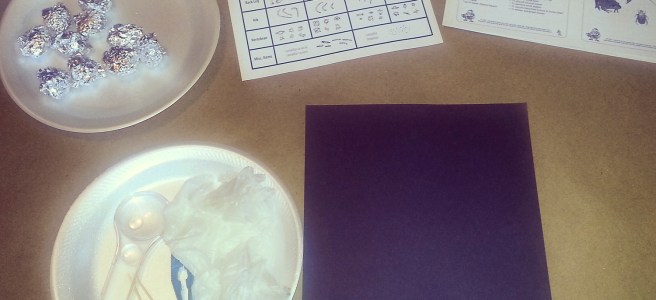
If you are easily grossed out, I’d recommend finding some other reading material for today. You can come back next post. I won’t judge. My daughter’s math book recently had a reference to owl pellets, which, she’d never heard of (I know…I’ve completely failed as a parent educator). So of course, relieve my guilt, and satisfy her curiosity, I put together a little pellet party. What can I say? I’m a nerd to the core. Continue reading

Rockets Review Game

My son played this review game with his tutor during our CC community day last year and loved it. It seems to have disappeared from CC Connected, so I attempted to recreate one for our own use. You can utilize it too…if you promise not to laugh at the slightly fuzzy around the edges version I created. My son thinks it’s great – that’s good enough for me. Continue reading

Science Experiment: Newton’s First Law of Motion

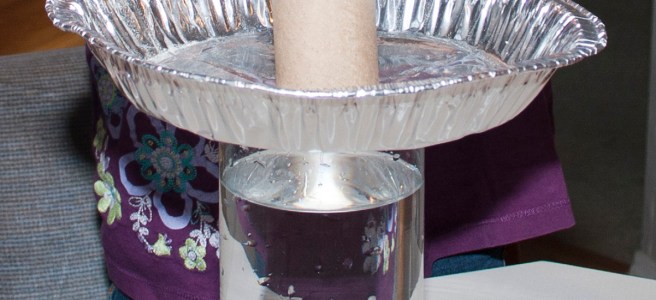
An object at rest tends to remain at rest, and an object in motion tends to continue moving in a straight line at constant speed unless an outside force acts upon it. So says Newton’s First Law of Motion. The question is…can you see this in action? You bet your sweet bippy you can. You only need a few simple materials for this crazy experiment.

A pie plate
An empty cardboard toilet paper tube
A raw egg (yes, raw)
Water
A large drinking glass or flower vase

Continue reading

Squirrels, Biomes, Clauses and Consumers

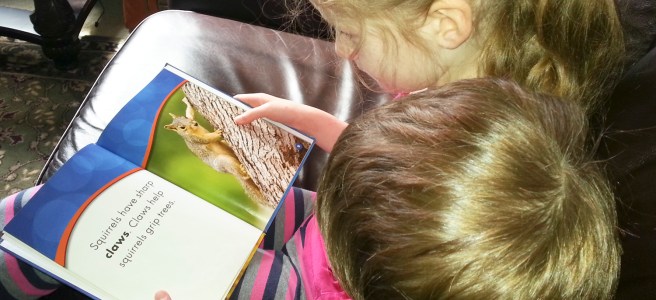
One of the most common questions I get regarding Classical Conversations is “You are just filling their head with rote memorization. They don’t  understand half of it. What good is that? All that stuff doesn’t even mean anything to them.”. While it is quite true that many of the facts we memorize mean virtually nothing to my children (what 5-year-old cares about Newton’s Laws of Motion?), there is a purpose and a path in our style of schooling that begins at the beginning. With young children who, like sponges, absorb every ounce of data around them. We all learn from infancy by rote memorization. How to speak by repeating the basic words our parents babble to us. The alphabet, the Pledge of Allegiance, The Lord’s Prayer. Kids can sing every song in their favorite movie. Recite entire books that are frequent bedtime stories. All these things are retained and recalled because of rote memorization. I’d like to share a little from Leigh Bortins book “The Core“, and then a story of my own to demonstrate these principles in action. Continue reading

SNAKE Math Game

Last week, I had the opportunity to observe an Essentials class at my CC Community. Even if the next level of classical education is a few years away for your family, I’d highly encourage anyone with a Foundations child to take a looksie at an Essentials class. It broadened my view of this whole classical journey, and renewed my excitement for the process. Seeing English and Math memory work come to life in real application was a great motivator to keep plugging along with all those songs about gerunds and verb conjugations. Bonus, I saw math games in action that I immediately stole, and have been using at home ever since. Including this fun game, called SNAKE.

Snake

You can play this as a multiplication or addition game. We learn skip counting in our Classical Conversations memory work, so my 6-year-old can rattle off multiplication as fast (maybe even faster) than his addition facts. We play both multiplication and addition to reinforce both as a good math foundation. Continue reading

Bending A Straw With Light

One of our very first experiments was exploring one of the characteristics of light. Our Classical Conversations science memory work this week was “What are three characteristics of light?”. One of the terms we covered was refraction. Which is exactly what this super easy experiment demonstrates — you probably have all the necessary items in your house already.

You only need:
A straw (or pencil)
A clear glass
Water
Full printable instructions and simple refraction explanation: Bending a Straw With Light
or here: Pencil Refraction Continue reading

Our Great Big 50 States Adventure – Part One

There are three cycles of information spanning Ancient History to Modern in Classical Conversations. This upcoming year (cycle 3) the focus is on US History and Geography. We’ll be memorizing the states and capitols, as well as geographical features and historical timeline events.

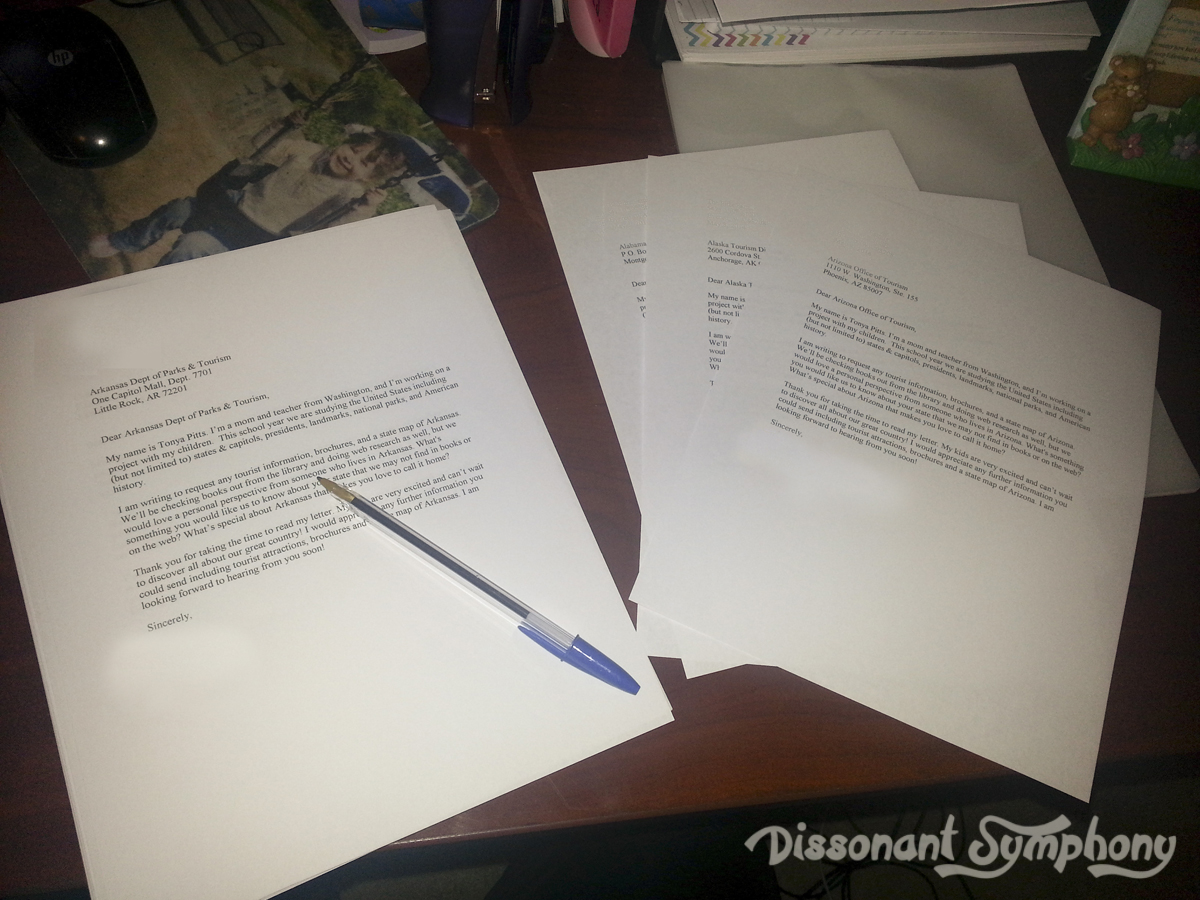
As we hone in on the United States next year, I thought it would be exciting and enriching to see what stories and facts I could get regarding each state, from people who actually live there. So, I’ve set upon a great adventure to collect information in the form of mail (good mail…the kind with a stamp on it) for my kids. Mail is just flat out fun. Bonus: I got to sign my name 100 times. I love signing my name.


Continue reading

Limited Time Only! Free Geography Curriculum!

50-states-freebie

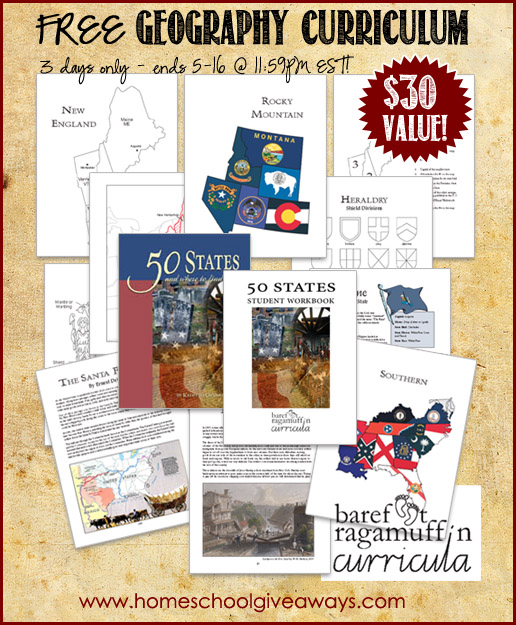
Anyone involved with Classical Conversations knows that Cycle 3 is all about the United States for Geography. Head on over to Homeschool Giveaways and pick up this freebie before it expires on Friday! Whether you’re sure you’ll be using it or not — get it before it’s gone! This would also make for great summer activities for any kid who’s studying US Geography or state history.

Included is 50 States and Where to Find Them, which teaches children the states and capitals region by region through mapping exercises and quality literature. Children fill out a map of the region as they learn about each state. State lessons include historical information about the state and coloring pages of the state flower, state bird, and state flag.

Each region wraps up with a crossword puzzle, a word search, and a bonus lesson pertaining to the region.  Bonus lessons include topics such as heraldry, the Erie Canal, and the Underground Railroad.

Also included is The Student Workbook for 50 States and Where to Find Them which is a necessary component of this program. It includes all of the printable, reproducible sheets needed to complete the work.

I love free! Did you know that most library systems allow you to print for free too? My local library system will even let you print a limited amount in color! Check out the libraries where you live – they are a great place to stretch your budget! Yippee!

Here’s the link again if you missed it earlier. Free Geography Curriculum